A City Too Large for a Single Day, Too Rewarding to Rush

Istanbul does not reveal itself easily. That is part of what makes it extraordinary.

Few cities in the world carry the weight of continuous history the way Istanbul does. Founded as a Greek colonial settlement around 657 BC, the city grew over millennia into the capital of three of history’s most consequential empires: Roman, Byzantine, and Ottoman. Each built upon, adapted, and transformed what came before. The result is not a city with a historical quarter. Istanbul is history, layered so densely that a single street can contain a Roman cistern beneath your feet, a Byzantine church converted to a mosque on your left, and an Ottoman han (a historic trading inn) still conducting commerce on your right.

For long-haul travelers making the journey from North America, East Asia, or the Pacific, Istanbul is often the first stop and the most anticipated destination. Understanding it well sets the tone for everything that follows.

The temptation with Istanbul is to attempt too much in too little time. The city has an abundance of famous landmarks, and first-time visitors often feel pressure to check off as many as possible. The result, more often than not, is a day that moves too quickly to absorb anything deeply.

The more rewarding approach is the opposite: choose a theme, follow it with focus, and allow the city to speak on its own terms.

Istanbul’s layers are best understood not as a single story, but as several distinct stories occupying the same space: the Byzantine story, the Ottoman story, the story of its minorities and merchants, the story of its neighborhoods and waterways, the story of its food and daily life. Each of these deserves its own day, its own pace, and its own kind of guide.

This is the principle behind Argeus’ approach to Istanbul. Rather than offering a single overview tour that skims the surface of everything, our Istanbul day trips are built around specific perspectives, each one designed to give travelers genuine depth within a clearly defined theme.

The UNESCO-listed Historic Peninsula is the natural starting point for any visit to Istanbul. Contained within the old city walls and surrounded on three sides by water: the Golden Horn, the Bosphorus, and the Sea of Marmara, this compact area holds a concentration of monuments that is difficult to equal anywhere in the world.

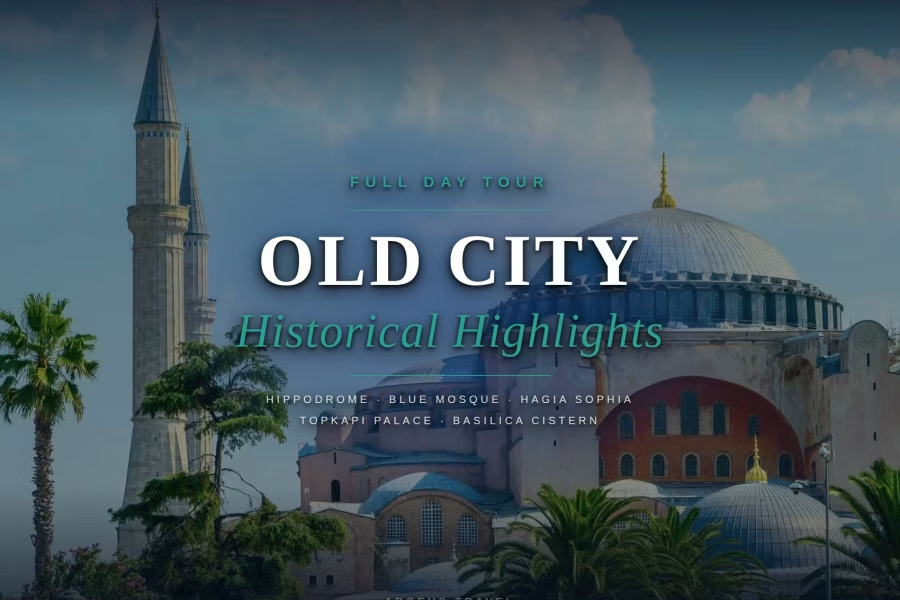
Step inside Hagia Sophia on a clear morning and the first thing that strikes you is not the mosaics or the calligraphy medallions. It is the light. It falls from forty windows at the base of the dome in a way that makes the entire structure appear to float. Built in the sixth century under Emperor Justinian, it remained the largest enclosed space in the world for nearly a thousand years, its dome engineered before the mathematics to fully explain it existed. The building has been a cathedral, a mosque, and a museum, and is now a mosque again. Each of these transitions left traces that a knowledgeable guide can read like a text.

Around it, the Hippodrome of Constantinople preserves monuments transported from across the ancient world: an Egyptian obelisk, a bronze serpent column from Delphi, a monument to Roman victory. Topkapı Palace, positioned at the tip of the peninsula with views across three bodies of water, served as the administrative heart of an empire that stretched from the gates of Vienna to the Persian Gulf. The Blue Mosque, the Basilica Cistern, and the city walls that still stand along much of the peninsula’s perimeter complete a landscape that rewards slow, attentive exploration.

The Old City Historical Highlights day trip is designed for first-time visitors who want a thorough, well-paced orientation to this core area, combining the major monuments with the historical and architectural context that gives them meaning.

Beyond the major monuments, the Ottoman city reveals itself through its commercial and religious infrastructure: a world of bazaars, mosques, hans, and waterfront life that shaped the daily rhythm of the empire’s capital for centuries.

Push through the gates of the Grand Bazaar on any weekday morning and the city immediately changes register: the light dims, the noise rises, and the corridors of vaulted stone open into a labyrinth of over four thousand shops that has been operating, more or less continuously, since the fifteenth century. It is far more than a shopping destination. It is an urban institution, a social space, and a living record of Ottoman commercial organisation. A few streets away, the Spice Market announces itself before you arrive: dried chilies, cumin, sumac, and fresh-ground coffee carrying through the air from the entrance. The hans of the old city tell the same story in quieter tones, through spices, textiles, copper, and leather, each one a trace of the trade networks that made Istanbul one of the wealthiest cities on earth.

The mosques of the Ottoman period reward unhurried visits. Climb the hill to the Süleymaniye Mosque in the late afternoon and you will understand why Mimar Sinan is considered the greatest architect of the Ottoman world: the courtyard opens before you, the dome rises above it, and the interior, cool and high, filled with a diffused light that the architect controlled with the precision of a craftsman, holds a quiet that the streets below do not. The smaller Rüstem Pasha Mosque, tucked into the bazaar district and reached through a market passage, contains some of the finest İznik tilework anywhere in the city, unknown to many visitors who never venture beyond the main tourist circuit.

Take the public ferry from Eminönü and the city reconfigures itself around you. Seen from the water, the minarets and domes of the Historic Peninsula stack against the sky in a silhouette that has changed surprisingly little in centuries; the Asian hills rise on the opposite shore; container ships move slowly through the strait that has always made Istanbul what it is. A Bosphorus crossing, even a short one, is not optional. It is how the city finally makes sense.

The Bazaars, Ottoman Art & Bosphorus day trip follows this thread, combining the Grand Bazaar, the Spice Market, the great mosques of the Ottoman period, and a scenic crossing of the strait.


Istanbul’s identity is not contained within its famous landmarks. Some of the most rewarding experiences in the city happen in its neighborhoods, places where the accumulated life of centuries continues in the form of architecture, food, social patterns, and street culture.

Beyoğlu, on the northern shore of the Golden Horn, hums at a different frequency to the Historic Peninsula. Walk the length of İstiklal Street on a weekend evening, past the old tram line, the nineteenth-century apartment facades, the music spilling from doorways, and you feel a city that is entirely present, not preserved. The surrounding lanes hold late Ottoman buildings, early Republican-era cinemas, meyhanes (taverns) that have been pouring rakı since before most visitors were born, and contemporary galleries that suggest a city still very much in conversation with itself.

Board the ferry from Karaköy or Eminönü to the Asian side and the pace drops almost immediately. Kadıköy‘s morning market, fish glistening on ice, seasonal vegetables stacked in bright rows, the sound of vendors and the smell of börek from the bakeries, is one of the most vivid ordinary experiences the city offers. The neighborhoods of Moda and Üsküdar each carry their own character, and the crossing itself, something millions of Istanbullites do every day as a simple commute, is for a visitor one of the finest free experiences in any city in the world.

The Cross-Continental Life & Historic Neighborhoods day trip and the Asian Side Explorer are designed for travelers who have already encountered the Historic Peninsula and want to move deeper into the city’s social and architectural fabric.

For travelers with specific interests, Istanbul offers extraordinary depth. Three of the city’s most significant cultural layers, Byzantine, Ottoman, and Jewish, each have their own geography, their own monuments, and their own histories that are rarely told in full on a general tour.

The Byzantine story is one of remarkable continuity and survival. Constantinople was the most sophisticated city in the medieval world for nearly a thousand years, and its legacy is written into churches, mosaics, cisterns, walls, and urban patterns that persist to the present day. The Byzantine Heritage Tour traces this story from the late antique city through the height of Orthodox civilisation and into the Ottoman adaptation that followed.

The Ottoman story, explored in depth on the Ottoman Heritage Tour, moves beyond the familiar landmarks to examine the institutions, theological schools, soup kitchens, libraries, caravanserais, and hamams, through which the empire organised public life and expressed its imperial identity.

The Jewish Heritage Tour explores one of Istanbul’s least-known but most historically significant communities, tracing Sephardic history from the fifteenth-century expulsion from Spain through to the present, through synagogues, neighborhoods, and a story of tolerance and coexistence that is genuinely rare in European history.

The Istanbul Food Tour takes a different approach entirely: this is Istanbul understood through taste and smell, through the slow negotiation of a market, a glass of tea pressed into your hand by a vendor, a plate of something you cannot name but will not forget. Food here is not an attraction. It is a cultural language, and the tour treats it as such. The Istanbul Photography Tour offers yet another entry point: early light on the Golden Horn, the geometry of a mosque courtyard, a fisherman’s silhouette on the Galata Bridge. For travelers who see through a lens, Istanbul is an endlessly generous subject.

Istanbul is a large, complex city, and a few practical notes can make a significant difference to the quality of a visit.

Arrive at Hagia Sophia or Topkapı Palace when they open and you will have the spaces largely to yourself: the light is better, the silence is real, and the scale of the buildings registers in a way it simply cannot when they are full. By mid-morning, particularly in summer, the main sites on the Historic Peninsula are very busy. The difference an early start makes is not a matter of comfort. It is a matter of experience.

The city is well connected by public ferry, metro, and tram, but traffic congestion can be significant. Building realistic timing into any day is important: Istanbul rewards a slower pace.

The best time to visit depends on priorities. Spring (April to early June) and autumn (September to November) offer the most comfortable temperatures and manageable crowds. Summer is lively but hot and busy. Winter is quieter and can be atmospheric, particularly along the Bosphorus: fog on the water, empty courtyards, the city in a more private mood.

Istanbul is a city that reveals more the more you know, and the more carefully you look. The difference between a day spent moving quickly between famous sites and a day spent following a coherent theme with a knowledgeable guide is, in our experience, the difference between having been to Istanbul and actually understanding it.

Argeus’ Istanbul day trips are designed to provide that second kind of experience. Each tour is built around a clearly defined theme, guided by specialists who bring genuine depth to their subject, and paced to allow for real engagement rather than rushed photography.

Whether you are in Istanbul for two days or ten, our day trips can be combined, sequenced, and adapted to match your interests and energy. We are happy to help you think through the best approach for your time in the city.

Browse our Istanbul day trips to find the perspectives that interest you most.

Stories, tips, and guides