A Landscape That Demands an Explanation

The first time most visitors see Cappadocia, they reach for their camera before they reach for words. The landscape seems to belong to another world: spires of pale rock rising from valley floors, cave openings carved into cliffs, entire underground cities hollowed out beneath your feet, and a horizon unlike anything else on earth.

Stand at the rim of the Göreme valley at first light and the scale of it settles in slowly. The fairy chimneys below catch the early sun on their capstones while the valley floor is still in shadow. Nothing moves. The silence is the kind that makes you aware of your own breathing. Cappadocia is not a fantasy, though it looks like one. It is the product of one of the most complex and prolonged geological processes in Anatolia’s history, and understanding even a little of that process transforms the way the landscape looks.

For travelers making the journey from afar, Cappadocia offers something rare: a place where geology, human history, and daily life are so completely intertwined that you cannot understand one without the others.

The story of Cappadocia’s formation begins not with volcanoes, but with the sea.

Around 66 million years ago, the land that would become central Anatolia lay beneath a shallow marine basin. It was the collision of the African and Eurasian tectonic plates, a slow, grinding process that began around 50 million years ago, that gradually pushed the seafloor upward. By approximately 35 million years ago, a large portion of Anatolia had risen above sea level, and the region that would become Cappadocia was emerging as a high plateau.

The volcanic activity that shaped the landscape came later. Beginning around 13.5 to 11 million years ago, massive eruptions from ancient calderas, volcanic systems far larger and more explosive than any single cone, began depositing thick sheets of ash and pyroclastic material across the plateau. These were not gentle lava flows. They were ignimbrite-forming eruptions of extraordinary power, comparable to events many times more violent than the 1980 eruption of Mount St. Helens. Each eruption left behind a distinct geological layer: the Kavak ignimbrite, the Zelve ignimbrite, the Kızılkaya ignimbrite, which alone covers more than 10,000 square kilometres.

Between eruptions, lakes and rivers deposited softer sedimentary layers, creating a geological layer cake of alternating hard and soft materials. The volcanoes visible on the horizon today, Mount Erciyes, Hasan Dağı, Melendiz, were late additions to this process, not its architects.

When volcanism eventually quieted, erosion took over. Rain, rivers, freeze-thaw cycles, and wind began cutting through the layered landscape. Wherever a harder capstone of welded ignimbrite or basalt sat above softer tuff, it shielded the column beneath, slowing erosion to a crawl. Where no cap existed, the softer rock wore away quickly. Walk through any valley in Cappadocia and you can read this process in the shapes around you: a tall, proud chimney with its cap still intact; a shorter one that has lost it and is slowly dissolving back into the plateau; a stump that was a chimney a thousand years ago. What you are looking at is not a finished landscape. It is a landscape in the middle of becoming something else.

The formations are called fairy chimneys, or peri bacaları in Turkish, a name that captures something the geological terminology does not: these shapes look as though they were made deliberately, by someone with a very particular sense of humour.


The name has a longer and more interesting history than most visitors realise, and a popular misconception worth setting aside.

The word Cappadocia entered European languages via the Greek Kappadokia, which was itself borrowed from the Old Persian Katpatuka, the name used by the Achaemenid Empire for this region in the 6th century BCE. For much of the 19th and early 20th centuries, scholars and travel writers popularised the idea that Katpatuka meant “Land of Beautiful Horses,” a romantic interpretation encouraged by the region’s historical association with horse breeding and by Persian reliefs at Persepolis showing Cappadocian emissaries leading horses as tribute.

Recent linguistic research has largely set this theory aside. The most widely supported explanation today, drawing on Hittite and Luwian sources, traces the name back to the Hittite phrase katta peda, meaning “Place Below” or “Lower Land,” a geographical description distinguishing the central plateau from the higher lands to the north. The Luwian people of the region adapted this term, which passed through phonetic shifts into the Persian Katpatuka and eventually into Greek. The “Land of Beautiful Horses” is a compelling story, but not a linguistically supported one.

It is also worth noting that the Cappadocia described by the Greek historian Herodotus was a far larger territory than the region visitors explore today, stretching across much of central Anatolia between the Taurus Mountains and the Black Sea. The modern usage of the name refers to a much more specific area, centred roughly on Göreme, Ürgüp, Avanos, and Uçhisar.

The same soft volcanic tuff that erodes into fairy chimneys also carves beautifully, and human communities recognised this early. The rock of Cappadocia has been cut, shaped, and inhabited for millennia, producing one of the most distinctive landscapes of human settlement anywhere in the world.

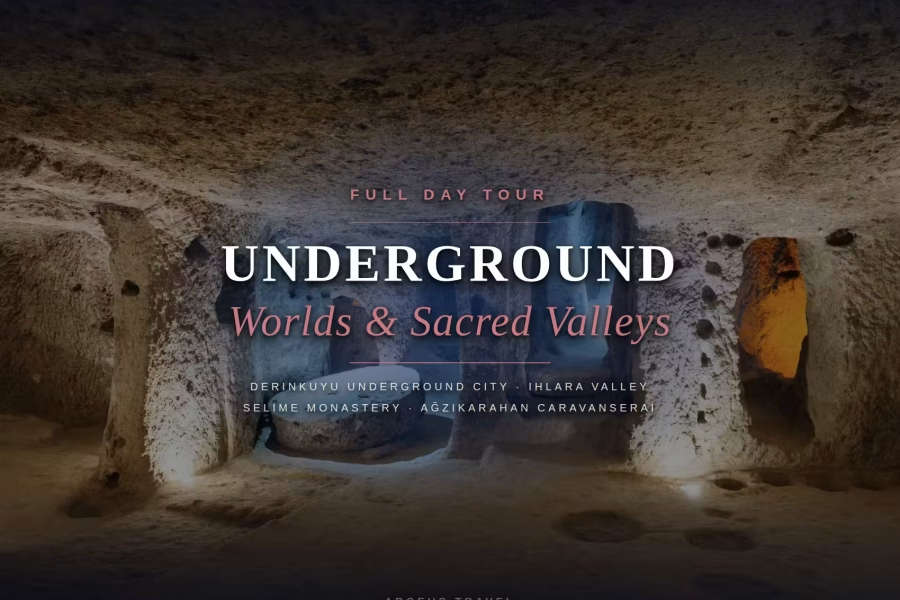
Descend into Derinkuyu and the temperature drops within a few steps. The air is cool and still. The passages narrow, the ceiling lowers, and the stone presses in from both sides. This multi-storey subterranean complex, capable of sheltering thousands of people, goes down eight levels. There are ventilation shafts, water channels, storage rooms, wine presses, and passages connecting to neighbouring systems kilometres away. Standing in it, you stop thinking about it as an archaeological site and start thinking about it as the decision of a community that had calculated, correctly, that survival required going underground. Kaymaklı, similarly vast and connected, tells the same story. Their precise origins remain debated, but both were substantially developed and used during the early Christian period, when communities sought protection from successive waves of invasion.

Above ground, the cliff faces and valley walls are carved with hundreds of rock-cut churches, monasteries, and dwellings, many decorated with frescoes in varying states of preservation. Step into one of the painted churches of the Göreme Open-Air Museum, a UNESCO World Heritage Site, and let your eyes adjust to the dim interior: saints look down from the curved walls, their gold grounds still faintly luminous, their faces worn smooth in places by centuries of touching hands. The context shifts here in a way that photographs taken outside do not prepare you for. Significant examples are scattered across the entire region, often in less-visited valleys where the absence of crowds makes the experience more intimate still.

The Byzantine communities that carved these spaces were not isolated. Cappadocia was a significant centre of early Christian thought, and several of its native thinkers, including the Cappadocian Fathers of the 4th century, shaped the development of Christian theology in ways that still resonate today. The landscape holds not just architectural evidence, but intellectual history.

Cappadocia’s valleys are the most rewarding way to experience the landscape at a human pace, and each has a distinct character shaped by its geology, its orientation, and its human history.

Rose Valley and Red Valley are best walked in the late afternoon, when the iron-oxide tones in the rock move through ochre and terracotta into a deep, glowing crimson as the sun drops toward the plateau. The colours are not static: they shift minute by minute, and a walk that begins in warm amber light can finish in something approaching rose gold. The interconnected trails pass cave openings, carved chapels with faded frescoes just visible in the dark, and viewpoints where the valley spreads out below in a way that makes it genuinely hard to leave.

Ihlara Valley in the south offers a different experience entirely. The drive out across the plateau gives no warning of what is coming: the land is flat, dry, and unremarkable, and then the gorge simply opens in front of you, the Melendiz River running green at the bottom, poplars and willows shading the banks, rock-cut churches visible in the cliffs above. After an hour on the plateau, the cool air rising from the valley floor is immediately noticeable. This contrast, arid above and lush below, is part of what makes Ihlara feel like a discovery rather than an attraction.

Göreme Valley and Pigeon Valley connect the main settlements and provide a sense of how the landscape was navigated historically. Love Valley, Zemi Valley, and Soğanlı each offer their own geology and atmosphere, with Soğanlı in particular preserving a living village alongside its rock-cut monasteries.

Cappadocia is best explored over several days, and Argeus’ day trips are designed as modular building blocks that can be combined and sequenced according to time, interest, and physical energy.

For first-time visitors, the Orientation & Landscapes day trip provides the essential geographic and geological context that makes everything else more legible. Understanding the formation of the landscape, the ignimbrite layers, the fairy chimneys, the relationship between rock types and valley shapes, changes the way the region looks for the rest of the stay.

The Historical Cappadocia & Underground Cities day trip moves deeper into the human story, combining rock-cut churches, monastic complexes, and the extraordinary subterranean world of the underground cities. The Valleys, Local Life & Cuisine tour takes a gentler approach, moving through villages, valley trails, and local kitchens to explore Cappadocia through its living culture rather than its monuments.

For those with more time or a specific interest in the southern region, the Underground Worlds & Sacred Valleys day trip extends the experience to Ihlara Valley, Soğanlı, and the deeper underground systems, presenting a longer historical perspective than the central area alone can offer. Travelers with limited time can choose I Have One Day in Cappadocia, a carefully paced overview that covers the essential highlights without sacrificing coherence for speed.

Active travelers have two excellent options on foot. The Cappadocia Hiking Tour 1: Red Valley & Meskendir and Cappadocia Hiking Tour 2: Gomeda Valley & Balkan Creek follow valley trails through natural formations and past abandoned settlements, offering a pace and intimacy that vehicle-based tours cannot replicate. For experienced riders, the MTB Tour: Valleys, Villages & Fairy Chimneys and the Half-Day MTB Tour: Valleys & Villages open up terrain that is genuinely inaccessible by road, covering high plateaus, farm tracks, and valley floors on routes designed for exploration rather than competition.

Set an alarm for before dawn, dress in layers, and make your way out to the launch field in the dark. The balloons are already being inflated when you arrive, enormous and glowing against the pre-dawn sky, the burners firing in long orange pulses. By the time you lift off, the first light is touching the plateau, and within minutes the valleys are below you, the fairy chimneys casting long shadows across the valley floors, the villages still quiet, a dozen other balloons drifting in the same pale air. There is no good way to describe this from the ground. It is one of those experiences that insists on being had rather than read about.

Balloon flights operate subject to weather conditions and are not always guaranteed, particularly in winter. They are worth planning around if the experience matters to you, and worth booking well in advance during the busiest seasons.

Cappadocia’s main visitor base is centred on the towns of Göreme, Ürgüp, and Uçhisar, each with a distinct atmosphere. Göreme is the most compact and walkable, with the open-air museum nearby. Ürgüp is larger, with more dining options and a lively town centre. Uçhisar is quieter, built around a dramatic rock citadel, and tends to attract travelers looking for a calmer base.

The region sits at around 1,000 to 1,200 metres above sea level, which means temperatures can swing significantly between day and night and between seasons. Spring and autumn are the most comfortable times to visit, with mild days and clear skies. Summer brings heat on the plateau but cool valley interiors. Winter turns the landscape white, the snow settling in the hollows of the fairy chimneys and along the valley rims, and the crowds thin to almost nothing. Cappadocia in January is a very different place from Cappadocia in August, and for some travelers it is the better one.

Most valley walks involve uneven terrain and some climbing. Comfortable footwear is important, and layers are worth carrying for early mornings, particularly on balloon days or hiking tours.

Cappadocia is a place where most visitors arrive with images in mind and leave with something harder to describe: a sense of having been somewhere genuinely unlike anywhere else, and of having understood, at least in part, why it looks the way it does.

Argeus has been operating in Cappadocia for decades. Our guides understand the geology, the history, and the living culture of the region in a way that adds real depth to every day spent here. Whether your interest lies in the rock-cut churches, the underground cities, the valleys, or the trails, we can help you structure a stay that matches your pace and priorities.

Browse our Cappadocia day trips to start planning your time in the region.

Stories, tips, and guides