
The western coast of Anatolia is one of the most historically consequential landscapes on earth. For more than three thousand years, the cities that rose and fell along this shoreline and its hinterland shaped the course of philosophy, science, religion, urban planning, and artistic achievement in ways that still resonate in the present day.
This is the world of the Ionian Greeks: city-states that produced the first philosophers to ask systematic questions about the nature of reality, the first urban planners to lay out cities on rational grids, the first sanctuaries that combined religious practice with medical healing. It is also the world of Rome’s most prosperous eastern provinces, of early Christianity’s most significant communities, and of artistic schools whose output supplied the entire Mediterranean world.
The Aegean coast extends further south toward Lycia and the Turquoise Coast, but Argeus’ Aegean day trips focus on the great classical and Hellenistic sites of the western interior and coast: Ephesus, Aphrodisias, Pamukkale, Priene, Miletus, Didyma, and Pergamon. Together, these sites form one of the richest archaeological itineraries in the world, and one that remains, for many travelers, genuinely life-changing.
Ephesus is the anchor of any Aegean itinerary, and with good reason. Few ancient cities anywhere in the world are as legible, as well-preserved, or as capable of conveying the sheer scale and complexity of urban life in the ancient world.
Walk down the main colonnaded street of Ephesus on a clear morning, the marble warm underfoot and the theatre visible at the far end, and the city stops being a ruin and starts being a city. Founded by Ionian Greeks and later transformed into one of Rome’s most important eastern cities, Ephesus at its peak was home to several hundred thousand people. Its marble-paved streets, monumental civic buildings, bath complexes, and public latrines are not isolated ruins scattered across a field: they form a coherent urban landscape that a visitor can walk through and, with good guidance, genuinely understand.
Turn a corner and the Library of Celsus stops you. Its two-storey facade, with its layered columns, carved niches, and sculpted figures, is one of the most complete and theatrical pieces of Roman architecture still standing anywhere in the world. It was built in the early 2nd century CE as both a funerary monument and a functioning library, and it has the quality of a building that knows exactly what it is doing. The Great Theatre, capable of seating around 25,000 people, still hosts performances today. Nearby, a single column rises from an empty field: all that remains above ground of the Temple of Artemis, one of the Seven Wonders of the Ancient World, a reminder of how completely time can erase even the most celebrated monuments.
Ephesus is also a significant site in early Christian history. The Basilica of St. John, built by Emperor Justinian in the 6th century, marks the traditional burial place of the apostle. The House of the Virgin Mary on the forested slopes above the city has been a place of Christian pilgrimage since the 19th century and attracts visitors of all faiths. The İsa Bey Mosque, built in the Seljuk period using materials from the ancient city, completes a picture of a site that was never simply abandoned but continuously adapted across civilisations.
The Ephesus Tour: Timeless Treasures of History and Faith is designed to present this full depth, moving through the city’s Ionian, Roman, and early Christian layers in a sequence that builds understanding rather than simply ticking landmarks.
Moving inland from the coast, the Maeander Valley opens into a landscape of remarkable contrasts: a city that became the marble-sculpting capital of the Roman world, and a natural phenomenon so visually striking that it has drawn visitors since antiquity.
Aphrodisias is, in the view of many archaeologists, the most underappreciated ancient city in Anatolia. Dedicated to Aphrodite and blessed with exceptional local marble, the city developed a school of sculpture whose works were exported across the Roman Empire. Spend an hour in the site museum and the quality of what was produced here becomes undeniable: portrait heads of extraordinary psychological depth, mythological reliefs of real technical ambition, works that travelled from this valley to Rome and beyond. Outside, the stadium is one of the best-preserved of the ancient world, its seating tiers still largely intact around a long oval field that once held 30,000 spectators. Travelers who arrive having heard less about Aphrodisias than Ephesus often leave more moved by it.
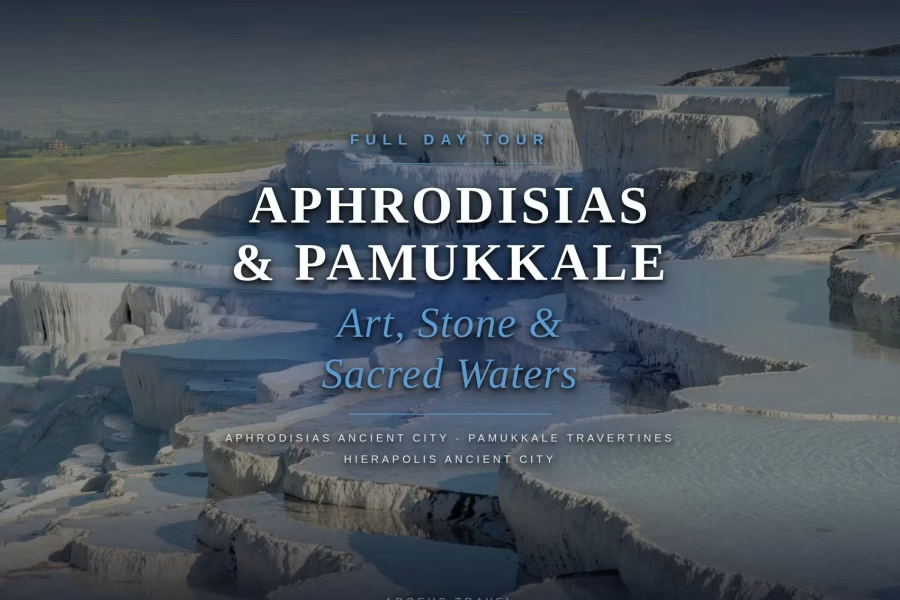
Nothing quite prepares you for Pamukkale. The white travertine terraces cascade down the hillside in layered pools of pale blue water, calcium-rich and warm to the touch, the formations catching the light differently at every hour. People have been coming here to bathe since antiquity, and the Greco-Roman city of Hierapolis that grew around the springs combined the functions of a spa town, a pilgrimage centre, and a conventional urban settlement. Walking barefoot across the travertines, the water cool against your feet despite the heat of the day, it is not difficult to understand why the ancient world considered this place sacred. Its Roman theatre, necropolis, and main streets are well preserved, and the combination of natural spectacle and archaeological depth makes Pamukkale a more substantial destination than its photographs suggest.
Both Aphrodisias and Pamukkale are UNESCO World Heritage Sites. The Aphrodisias & Pamukkale Tour: Art, Stone & Sacred Waters connects them in a single well-paced day that traces the intersection of artistic ambition, natural wonder, and ancient belief.
South of Ephesus, three ancient sites stand in close proximity, each representing a distinct dimension of the ancient Greek world. Taken together, they offer an unusually complete picture of how Ionian civilisation organised itself intellectually, politically, and spiritually.
Priene sits on the steep slopes of Mount Mykale, and the climb to reach its upper terraces is part of the experience. The city is compact and quiet, far less visited than Ephesus, and its grid of streets laid out with almost theoretical precision on a hillside that refuses to be flat gives it a peculiar clarity. From the Temple of Athena Polias, attributed to the architect Pytheos, the Maeander plain stretches out below, the river visible in the distance where it once formed a harbour. Alexander the Great contributed to the temple’s construction when he passed through in 334 BCE. He had good taste.
Miletus was one of the most influential city-states of the ancient world, a major maritime trading power, the founder of dozens of colonies around the Black Sea and Mediterranean, and the birthplace of philosophers including Thales, Anaximander, and Anaximenes, who in the 6th century BCE began asking systematic questions about the composition of the natural world. Stand at the top of the vast Roman theatre and look out over the site: the land that stretches to the horizon was once open sea. The coastline silted away over centuries, stranding the great port city kilometres from the water, and the melancholy of that abandoned geography gives Miletus a particular quality that the busier sites do not have.
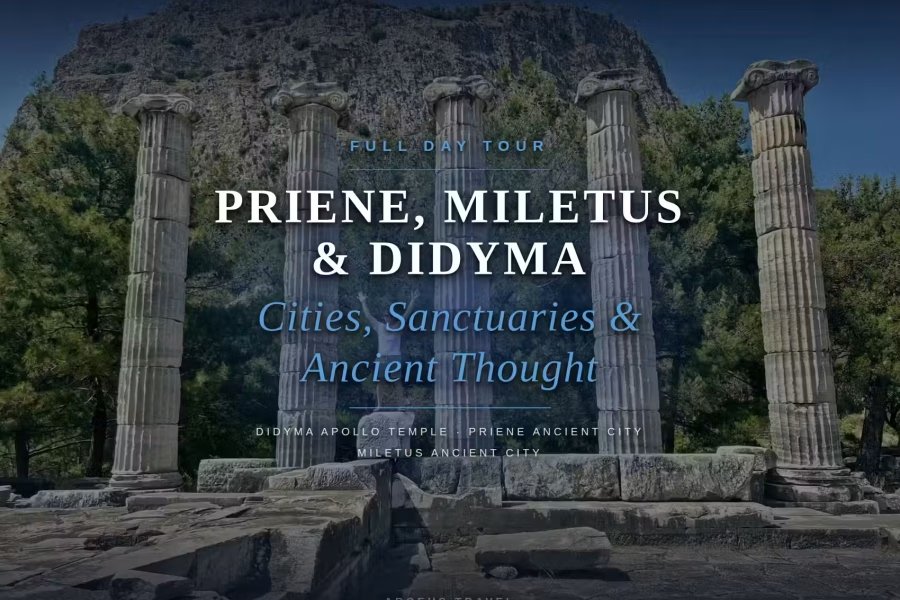
Didyma was not a city but a sanctuary, home to the Temple of Apollo, one of the largest oracle temples of the ancient world, connected to Miletus by a sacred processional road. Construction began in the 4th century BCE and never finished. Walking among the columns, some still standing to their full height, others toppled and lying where they fell, you are inside a building that was under active construction for the better part of five hundred years and still was not complete when the ancient world ended. The scale of the ambition is staggering. So is the scale of the failure. Both are worth standing in for a while.
The Priene, Miletus & Didyma Tour: Cities, Sanctuaries & Ancient Thought traces this triangle of sites in a sequence that reveals the intellectual and spiritual geography of the ancient Ionian world.
Further north, rising above the Bakırçay Valley on a steep and commanding hilltop, Pergamon represents a different kind of ancient city: not a coastal trading hub or a philosophical centre, but the capital of a Hellenistic kingdom that briefly rivalled the great powers of the ancient Mediterranean, and a city that took the life of the mind, its libraries, scholarship, medicine, as seriously as military and political power.
The Acropolis of Pergamon is a UNESCO World Heritage Site. Ride the cable car up and the city reveals itself gradually: temple platforms, royal terraces, and the theatre carved directly into the steep hillside at an angle so precipitous that sitting in the upper rows, the stage below seems almost vertical and the valley beyond stretches to the horizon. The most famous monument, the Altar of Zeus, one of the great sculptural achievements of the Hellenistic world, is now in Berlin, but what remains conveys the ambition of a kingdom that also housed 200,000 scrolls in its royal library and gave the world the word parchment (pergamena in Latin, named after the city).
Below the Acropolis, the Asklepion was one of the most important healing sanctuaries of the ancient world: a place where patients sought cures through a combination of physical treatments, water therapies, music, and dream interpretation guided by priests of Asklepios. The physician Galen, one of the most influential medical writers in history, was born in Pergamon in the 2nd century CE and trained at the Asklepion. The Red Basilica in the lower city, a massive Roman structure originally dedicated to Egyptian deities and later incorporated into early Christian use, completes a site whose layering is almost bewildering in its depth.
The Pergamon Tour: Power, Healing & Sacred Knowledge explores all three of these distinct zones in a single day, tracing the convergence of politics, medicine, scholarship, and faith that made Pergamon one of the ancient world’s most remarkable cities.
The main bases for Aegean day trips are Kuşadası, Selçuk, and İzmir, each with a distinct character and a different relationship to the sites.
Selçuk is the closest town to Ephesus and the most convenient base for the southern sites. Small and increasingly well-served by accommodation and restaurants, it suits travelers who want proximity to the archaeological sites without the bustle of a larger resort. The ruins of the Basilica of St. John are visible from the town centre, and the storks that nest on the ancient columns in spring are one of those details that make a place feel genuinely lived-in.
Kuşadası is a larger coastal town with a busy harbour and a more resort-oriented atmosphere. It is a common base for cruise passengers and offers good logistical convenience for day trips across the region, though its character is more commercial than historical.
İzmir, Türkiye’s third-largest city, is the regional capital and the main transport hub. Walk the Kordon, the long waterfront promenade, on a summer evening: the Aegean breeze comes in off the bay, the cafes are full, and the city feels easy and unhurried in a way that surprises many visitors who expected something more provincial. İzmir has a strong cafe culture, a genuinely good archaeological museum, and a cosmopolitan energy that reflects its long history as a port city open to the world. Travelers who base themselves here and make day trips to the ancient sites get a more complete picture of the Aegean region than those who stay exclusively near the ruins.
The Aegean sites involve significant walking, often on uneven or sloped terrain. Ephesus in particular requires comfortable footwear and benefits from an early start: it is one of Türkiye’s most visited attractions, and the difference between arriving at opening time and arriving mid-morning is considerable both in terms of crowd levels and temperature.
Spring (April to early June) and autumn (September to October) are the ideal seasons for the Aegean. Summer is hot and the major sites, particularly Ephesus, become crowded. Winter is mild by Anatolian standards and quiet, and many sites are at their most atmospheric in the low season.
Most Aegean day trips depart from Kuşadası or Selçuk. Travel times to sites such as Pergamon or Aphrodisias are longer, and these are best treated as full-day commitments. Pamukkale involves an inland journey of approximately two hours each way from the coastal base.
The Aegean region rewards travelers who arrive with curiosity and leave with questions. These are not simply picturesque ruins: they are places where the foundations of Western philosophy, medicine, urban planning, and early Christian community were laid, and where the evidence of that history is still, remarkably, visible and walkable.
Argeus’ guides bring specialist knowledge of classical archaeology, early Christian history, and the broader cultural context that connects these sites to each other and to the present. Whether you are visiting the Aegean as part of a longer journey through Türkiye or focusing your time here entirely, we can help you build an itinerary that does justice to what the region has to offer.
Browse our Aegean day trips to explore the ancient cities of western Anatolia.
EXCELLENTVerified FAMILY HOLIDAYS IN CAPPADOCIA We were three families with young children, and we all had an amazing time! Our tours were very well guided by our guide, Cihan. Our transfers were always on time, and the hotel they recommended was amazing. We saw all the beautiful parts of Cappadocia, and the activities were very well organized. We even went horseback riding. I highly recommend them! Thank you for the unforgettable experience.Posted onVerified Fun and very interesting trip. We saw a lot of what Turkey has to offer in a short time ( two weeks) What we enjoyed about the trip:- the guide was amazing! Very knowledgeable, approachable, fun- the driver was good and careful, always attentive- all the food was delicious and plentiful - the captain, chef and crew on the boat were great- the sites were fantastic! Good choice of variety- the boat tour in Istanbul was interesting- the accommodations were very good, some better than others Where improvement would be beneficial:- the van was really cramped for 12 of us ( 10 plus the guide and driver)- two long days in the van were tedious and somewhat uncomfortable- a flight or two would have been easier -the gullet was tired. The wood was peeling, some of the water toys were broken - some of had our toilets back up into our bathrooms - a bad stench was present in the cabins in the bathrooms at timesPosted onVerified Fantastic highlights of Turkey tour Our group of ten thoroughly enjoyed our tour of Turkey with Argeus. Our guide, Sukru, was exceptional—knowledgeable, attentive to everyone’s needs, and a master at organizing wonderful meals. Highlights included magnificent mosques and palaces, atmospheric underground cisterns and cities, vibrant markets, centuries-old monasteries, fascinating cave dwellings, and the awe-inspiring ruins of Ephesus. We especially loved our days on the Mediterranean aboard a gulet—warm enough for swimming and perfect for pure relaxation.The trip was flawlessly organized, with every detail easily accessible through a user-friendly app. We highly recommend Argeus—they truly bring Turkey to life through their Highlights Tour!Posted onVerified Turkish holiday Cihan exceeded all of our expectations for our dream trip to Turkey. He arranged flights and drivers and tour guides and activities for Istanbul, Kusadasi and Capadoccia and they were all amazing. We love the food and the people and the history in Turkey and would highly recommend traveling there and using Argeus for your travel.Posted onVerified 12-day private tour of Turkey I had always booked and organized our previous holiday but this time i decided it would be better to use a travel agent.I found Argeus after some research through Turkey travel planner.The communication and emails with Cihan were very professional and personal when organizing our trip. Cihan planned our customized private tour of Turkey in late April early May 2025. Cihan was very flexible in adding or removing things from the itinerary as we requested to create 12-day trip around TurkeyWhile in Turkey, we had great drivers and guides, even had the pleasure of having Cihan in Cappadocia and his knowledge of the area and organizing our days was wonderful from the area's history to wonderful food. Our guide Faruk in Istanbul was great he had our days planned to show us the sights and he did a great job introducing us to the Turkish food by taking us to amazing local restaurant and advising us different dishes to try every day!To see how different Türkiye is and the history just amazed us.We would highly recommend Argeus Travel to plan any trip and we thank them for showing us around their countryPosted onVerified Excellent tour agency for customized trip We had a 12-day customized private tour of Turkey with Argeus in April 2025. We communicated with Cihan by email during the planning process and he was very flexible in adding or removing things from the itinerary as we requested to create our trip. While in Turkey, we had a great driver, Mustafa. Our guide Faruk did a wonderful job of organizing our days and showing us the sights, always adding a few surprises along the way. He did an especially great job introducing us to the Turkish cuisine by suggesting different dishes every day! Overall, we thank Argeus for an outstanding first trip to Turkey and would highly recommend their agency.Posted onVerified Impeccable planning making for an smooth and unforgettable trip One of the concerns travelers have when visiting a new country is simply the fear of the unknown. From our initial interaction with Cihan before we arrived in Turkey until the day we left, was the sense of calm and confidence that he exhibited and transferred to ourselves. Everything we did was well planned and even when he was not physically present we knew he was keeping an eye on us and available for any questions that we had. We enjoyed ourselves thoroughly and using his services saved us valuable time trying to learn the nuances of moving around in a new landscape. I highly recommend Argeus services. The additional expense involved in good preparation and efficient use of the limited time that one has on a vacation was well worth it. We had a flawless trip and returned home with wonderful memories!Posted onVerified Great Tour & Travel Operators Cihan and his associates were extremely helpful and proffesional. All the hotels, tours and travel arrangements were well chosen and appropriate.Posted onVerified A wonderful, stress-free trip to Turkey Argeus Travel was recommended to me by a friend, and I’m so glad they did. We used them to plan our 11-day trip to Istanbul, the Aegean coastline, and Cappadocia. The itinerary they created was excellent, and everything went smoothly. I especially appreciated the responsiveness of our primary contact, Cihan, who was always available and quick to reply to my emails and texts. Argeus made everything easy for us—from the guides and transfer services to pre-paid hotels, admission fees, and lunches with our guides being included in the fee. It all made for a stress-free and enjoyable experience. Argeus are true experts in Turkey, and I would absolutely use them again. Highly recommended!